

The five phases of project management and how smart systems make them work
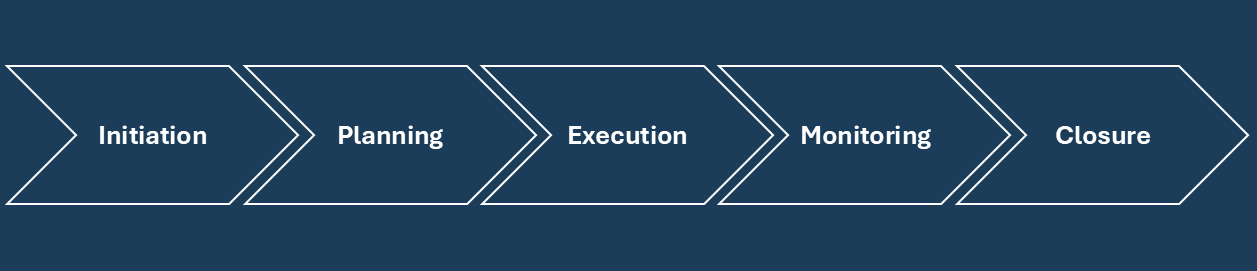
At the heart of every successful project is a clear structure. The five phases of project management: initiation, planning, execution, monitoring, and closure provide that structure and are widely understood across organisations of all shapes and sizes.
They’ve been around in a very similar form since the 1950s but the environment in which they operate is almost unrecognisable.
Projects today move faster, involve more stakeholders, generate more data, and rely on more tools than ever before. This speed and complexity means systems are no longer a nice to have, they are essential to making each phase work effectively and at scale.
Phase 1: Project Initiation - turning ideas into structured decisions
Initiation is about defining purpose, scope, and feasibility. In practice, some projects can already find themselves on shaky ground as inputs arrive via emails, conversations, documents, or spreadsheets, with no consistent way to capture, assess, or prioritise them.
It’s this sort of data gathering and organisation that we often help clients bring structure to. Using collaborative work management platforms, supported by our own smarter apps, we create centralised intake processes that capture ideas consistently and make evaluation transparent.
Stakeholders can see everything in one place: what’s been proposed, why it matters, and how it aligns with business goals.
The result is better decisions, made earlier, with clarity and confidence.
Phase 2: Project Planning - creating a live, visible roadmap
Planning defines how a project will be delivered, but too often plans are static. Once created, they quickly fall out of date, leaving teams working from different versions of the truth.
We help our clients build live project structures, supported by automation and dashboards, to ensure that scope, timelines, ownership, and risks are always visible and up to date. These plans become working tools rather than documents that gather dust.
This visibility allows teams to adapt quickly without losing control which is a critical capability in modern delivery environments.
Phase 3: Project Execution - keeping work moving without the chasing
Execution is where delivery happens, but it’s also where project managers can become bottlenecks, spending their time chasing updates and running status meetings instead of enabling progress.
It’s easy to remove this sort of friction by automating workflows. With a bit of smart thinking, tasks can update as work happens, issues can trigger alerts, and dashboards replace manual status reporting giving a much richer picture of the status of the whole project, at a glance.
This allows project managers to focus on leadership and problem-solving, while teams get on with the work.
Phase 4: Monitoring and Controlling - one view everyone can trust
Monitoring performance shouldn’t require pulling data from multiple systems and reconciling spreadsheets, yet this is still the reality for many organisations.
Much of the work we do with clients specialises in creating single sources of truth. Through integrations, dashboards, and smarter reporting, we bring key metrics together into clear, reliable views. Leaders can instantly see how projects are performing, where risks sit, and where decisions are needed without waiting for reports.
Our Smarter Dashboards are key to providing dynamic views of real data with the ability to edit the records directly providing instant update.
Phase 5: Project Closure - turning delivery into learning
Closure should be about so much more than just ticking a box. It’s an opportunity to capture insight and feed it back into future work.
We build systems that retain project data, documentation, and outcomes in structured, reusable ways. Lessons learned can then be captured and used to inform planning, estimation, and governance going forward. It’s the difference between simply completing a project and implementing continuous improvement throughout your business.
Systems are no longer optional
In summary, the five phases of project management may provide a relatively unchanged framework, but smart systems are what make that framework effective.
At Smarter Business Processes, we support organisations with the platforms, integrations, dashboards, Smarter Apps, training, and consultancy needed to deliver projects with clarity and control instead of workarounds.
If you’d like to explore how we can help you modernise your project delivery, contact us.
